
In-house vs outsourced customer support: a true cost breakdown for 2026


Every growing business hits the same wall at some point. The founder (or that one overworked team member) can no longer keep up with the ticket queue. Emails go unanswered. Response times slip. And so the decision arrives: hire someone in-house, or outsource?
Most businesses make that call on instinct. “Outsourcing feels cheap and risky.” “Hiring feels like doing it properly.” Few actually run the numbers. This article does it for you, across both the UK and France, so the decision can be made on something more solid than gut feeling.
TL;DR
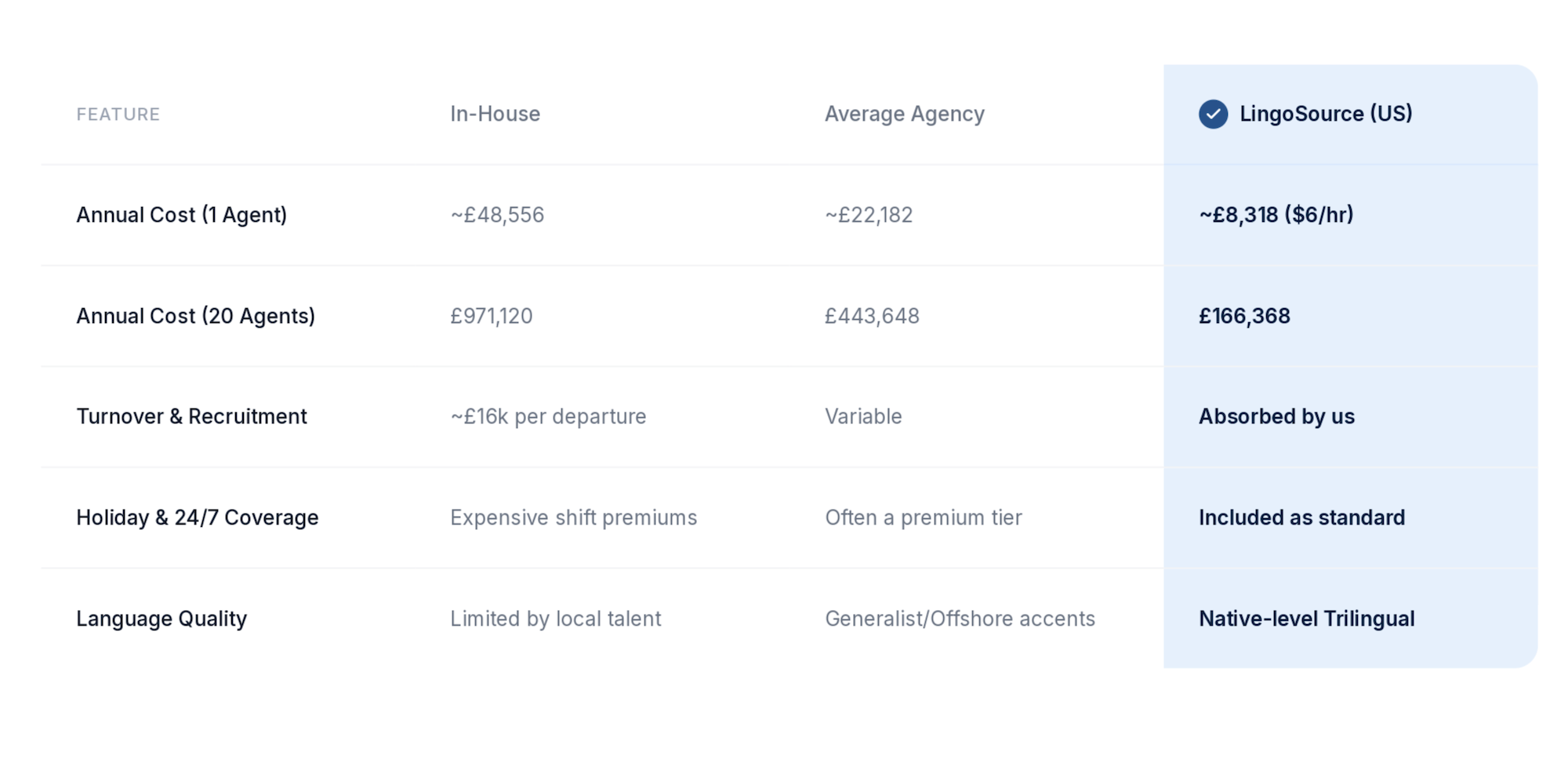
A single in-house support agent in the UK costs closer to £48,556 per year once salary, taxes, benefits, office space, software, and turnover are fully accounted for. The same coverage through a nearshore provider runs about £22,182 at market rates, or as low as £8,318 with LingoSource at $6.00/hr. For a 20-agent team, that difference is worth more than £800,000 a year. The rest of this article shows exactly how those numbers are built.
The full cost of an in-house support hire (not just salary)
Most businesses budget for salary and stop there. That line item typically covers less than half the real cost of bringing someone on. Here is what the full picture looks like across both the UK and France.
Base salary
In the UK, the median salary for a customer support advisor is £28,000 per year, though the range is wide. London commands a median of £32,200; Belfast averages closer to £25,500. The National Minimum Wage for workers aged 21 and over reached £12.71 per hour in April 2026, compressing the gap between entry-level and mid-career agents and pushing base salaries upward across the board (HMRC, Gov.uk, April 2026).
In France the picture is similar. The national average gross salary for a customer service agent is €30,851 per year, with entry-level roles typically starting at €23,699. The statutory minimum wage (SMIC) sits at €1,823.03 gross per month (€12.02/hour), and sector-wide collective bargaining agreements (conventions collectives) often mandate pay above even that floor (SalaryExpert France, June 2026; Slasify, January 2026).
Employer taxes and statutory contributions
Salary is only the starting point.
In the UK, employers pay Class 1 National Insurance Contributions at 15% on all earnings above £5,000 per year. That threshold was cut from £9,100, so businesses now owe NIC on a much larger share of each agent’s salary (HMRC, April 2026). For an agent on £28,000, that is £3,450 per year in employer NIC before anything else. Auto-enrolment rules add a minimum 3% employer pension contribution on qualifying earnings on top of that (The Pensions Regulator / Drewberry Insurance, January 2026).
In France, the statutory burden is considerably heavier. Employer social security contributions (charges patronales) add between 42% and 45% on top of gross base pay, across health insurance (13%), family allowances (5.25%), unemployment insurance (4%), and supplementary pension via AGIRC-ARRCO (Boundless HQ, May 2026; Service-Public France, January 2026). For an agent on a €30,851 base, that is roughly €13,000 to €14,000 in mandatory employer costs before a single shift is worked.
Benefits, paid leave, and sick pay
In the UK, the average employer spends about £1,500 per agent per year on benefits: health coverage, wellness allowances, and similar perks. That sits on top of statutory sick pay entitlements and a minimum of 28 days’ paid leave (Drewberry Insurance, January 2026).
France sets a higher floor by default. The 35-hour working week, five weeks of paid leave, employer-subsidised meal vouchers (tickets restaurant), and mandatory complementary health insurance (mutuelle) are standard contractual obligations, adding material cost above an already heavy contributions load.
Equipment, software, and office space
A serviced office desk in the UK averages £624 per month (£7,488 per year), covering utilities, business rates, internet, and cleaning (Work.Life, May 2026). In Paris, the equivalent runs €400 to €800 per month (€4,800 to €9,600 annually) (Workaround, January 2025).
Software is a separate recurring cost. A Zendesk Suite Professional licence is $115 per month per agent ($1,380 per year), with optional AI tooling at another $50 per month. Freshdesk’s omnichannel plan starts at $79 per month per agent, with usage-based AI resolution fees of $0.50 to $2.00 per automated deflection creating unpredictable overages (Corebee, January 2026; Pluno AI, January 2026).
Management and training overhead
Every in-house agent needs supervision. The industry standard is one supervisor per 15 agents, which means management is a real recurring cost whether you hire a dedicated team lead or pull a senior employee away from other work.
New agents also need structured onboarding. The average cost per new hire in the UK runs £1,530 to £1,870, covering training and mentor time (ExpertSure, May 2026). That figure does not include the three-month ramp-up period during which a new agent typically runs at well below full capacity.
Turnover: the cost nobody budgets for
Customer support has some of the highest attrition of any business function. UK call centre roles see annual voluntary turnover of 30% to 45%, with a 2026 projection averaging 36% (Insignia, January 2026). The average agent tenure is 13.7 to 14.3 months. Most agents leave before the business has recovered its onboarding investment.
Replacing a leaver costs roughly 60% of their annual salary, per CIPD benchmarks. For an agent on £28,000, that is £16,800 per departure, accounting for agency fees (typically 15% to 30% of first-year salary), advertising, HR time, and lost productivity during the gap (CIPD / ExpertSure, May 2026). With a 36% attrition rate across a 10-agent team, that is three or four replacement cycles per year, quietly adding £50,000 to £67,000 to the annual bill.
What one UK agent actually costs per year
| Cost component | Annual cost |
|---|---|
| Base salary | £28,000 |
| Employer NIC (15% above £5,000) | £3,450 |
| Auto-enrolment pension (3%) | £690 |
| Benefits package | £1,500 |
| Serviced office desk | £7,488 |
| Software licence (Zendesk Suite Pro) | £1,380 |
| Subtotal (before attrition) | £42,508 |
| Attrition cost (36% rate, 60% salary) | £6,048* |
| Fully-loaded total per agent | ~£48,556 |
Attrition cost prorated per agent: £16,800 replacement cost x 36% annual probability of turnover.
In France, applying the same structure to a €30,851 base salary with a 42% to 45% social charge load, equivalent office costs, and the same software overhead, the fully-loaded annual cost per agent lands between €58,000 and €65,000 before attrition.
The salary number on a job posting represents, at best, 57 cents of every euro or pound you will actually spend on an in-house support agent.
The full cost of outsourced support
What outsourcing actually costs per hour
Outsourced support is priced by the agent hour, and the rate varies by region. For UK and French businesses, the main tiers look like this:
Offshore locations in South Asia (India, Philippines) run $6.00 to $14.00 per agent hour. That tier works well for email queues, back-office tasks, and structured live chat where native-accent fluency is not critical to outcomes.
North African nearshore (Algeria ,Egypt, Morocco) runs $7.00 to $25.00 per hour. Covering English and French bilingual support at $7.00 to $16.00/hr. Eastern European nearshore (Poland, Romania) ranges from $12.00 to $25.00/hr, preferred for technical B2B support and GDPR-sensitive workloads.
LingoSource sits at the floor of that entire range at $6.00/hr per agent. That matches the most competitive offshore rates while delivering native-level English, French, and Arabic from Algeria, a combination far-offshore tiers typically cannot offer.
Sources: Call Force Global Pricing Index (May 2026); Ever-Help Cost Analysis (July 2026); WorkTime Regional Guide (January 2026)
What the rate includes and what it does not
Most providers in the $12.00 to $25.00/hr nearshore tier bundle in agent wages, local employer taxes, supervisor coverage, hardware provisioning, and basic quality assurance. What almost every provider excludes, regardless of price point, is client-side CRM or ticketing software (Zendesk, Freshdesk), custom API integrations, and bespoke training materials the client develops.
LingoSource keeps it simpler. The rate covers the agent; you control the tooling, the workflows, and how the operation runs. As well as covering agent salaries for the entire duration of the training period, so you are not paying for someone who is not yet working. That removes a cost line in-house hiring always carries.
Source: Call Force Loaded Rate Study (May 2026)
No recruiting, no benefits, no idle cost
In-house hiring carries costs that simply disappear in an outsourced model. No recruitment fee (typically 15% to 30% of first-year salary for agency-led hires in the UK). No employer NIC (15% on earnings above £5,000 in the UK, or 42% to 45% in France). No pension contribution. No benefits budget. No replacement cycle when someone leaves.
With LingoSource, the vacancy, the recruiter, the ramp-up period, and the replacement cost do not exist. There is no employment relationship between you and the agent, no statutory obligations, and no productivity gap while a new hire gets up to speed. The 36% annual attrition that drives so much hidden cost in in-house support teams is simply not your problem.
Sources: HMRC Employer Rates Gov.uk (April 2026); Boundless HQ French Payroll Guide (May 2026); The Pensions Regulator / Drewberry Insurance (January 2026); Insignia Turnover Analysis (January 2026); CIPD via ExpertSure (May 2026)
Scaling without the severance risk
Most nearshore providers can scale headcount within a week or two. LingoSource can typically onboard additional agents within a few days, with no minimum commitment and no long-term contract. For an e-commerce business managing a seasonal peak, or a SaaS team preparing for a launch, that flexibility has real financial value.
Scaling back is just as clean. No redundancy process. No notice period. No HR exposure. Support capacity tracks your business volume instead of becoming a fixed overhead you manage around.
What the numbers look like per agent, per year
At a typical nearshore market rate of $16.00/hr (roughly £12.80/hr), covering wages, local taxes, supervision, hardware, and QA, and using 1,733 productive hours per agent per year:
Market average nearshore cost per agent: ~£22,182/year
At LingoSource’s rate of $6.00/hr (roughly £4.80/hr):
LingoSource cost per agent: ~£8,318/year
For a 20-agent team, the three models side by side:
| Model | Annual cost (20 agents) |
|---|---|
| In-house UK (fully loaded) | £971,120 |
| Market average nearshore BPO | £443,648 |
| LingoSource at $6.00/hr | £166,368 |
Source: Operational Financial Synthesis model; Call Force Savings Guide (May 2026); HMRC Rates Gov.uk (April 2026); Work.Life Office Price Report (May 2026)
What you are not giving up
Language quality and native-level fluency
The most common objection to outsourced support is fluency. It is a fair concern when the wrong provider is chosen. It is not an inherent feature of the model.
North Africa produces some of the densest pools of native or native-equivalent French and Arabic speakers outside Western Europe, alongside strong English. LingoSource agents are based in Algeria, where trilingual fluency across English, French, and Arabic comes from the country’s education system and linguistic history rather than a language training programme. That matters commercially. Research from CSA Research found that 75% of consumers are more likely to repurchase from a brand when after-sales support is in their native language, and 64% of business executives report losing sales directly to language barriers. For businesses serving UK, French, and Arabic-speaking customers, that trilingual coverage at $6.00/hr is genuinely difficult to match through in-house hiring at any rate (CSA Research via Armatis, March 2026; Language Testing International, January 2023).
Coverage hours
An in-house team works contracted hours, typically a standard working day five days a week. Adding evenings, weekends, or full 24/7 coverage means shift premiums, more headcount, and the full employer cost stack for every additional hire.
LingoSource covers the full year including public holidays, at no surcharge. Many providers bill holiday coverage as a premium tier; it is worth checking before signing anything. The data on why this matters: 89% of customers expect an email reply within one hour, but the cross-industry average is over 12 hours. For live chat, customers expect a response in under 30 seconds; the actual average is 2 minutes and 40 seconds. A team that goes offline at 5pm is structurally behind those benchmarks before a ticket is opened (Ringly SLA Benchmarks, June 2026; Crisp Chat Benchmark, June 2026).
Training and quality control
LingoSource puts training in your hands. You brief the agent on your product, your tone, and your processes. The agent who works with your customers is trained on your business specifically, not on a generic onboarding curriculum recycled across dozens of clients. LingoSource covers the cost of that training period, so you are not paying hours for someone who is not yet useful. Day-to-day performance management stays with you, which for most businesses is the right arrangement. The standard your customers experience is the one you set.
When in-house still makes sense
Outsourcing is not right for every business.
If your product requires agents to hold specific certifications (medical device support, financial services compliance, legal queries), internal hiring is often the more defensible choice, even at higher cost. The regulatory accountability is harder to structure into an outsourced relationship.
If your support volume is very low and stable (under 10 to 15 interactions a day with no growth trajectory), a single part-time hire or a well-managed shared inbox may be simpler than a formal outsourced arrangement.
If your product changes weekly and agents need continuous access to your engineering or product teams to stay current, embedded in-house agents may be a better operational fit, at least in the early stage.
The real question is not whether outsourcing is cheaper (it usually is). It is at what volume, what complexity level, and what growth rate the flexibility and cost of outsourcing outweigh the control benefits of in-house. For most scaling e-commerce brands and SaaS businesses past the early stage, that crossover arrives earlier than expected.
The numbers make the decision
A fully-loaded in-house UK support agent costs roughly £48,556 per year. A team of 20 costs £971,120 annually, accounting for salary, NIC, pension, benefits, office, software, and a realistic allowance for turnover.
A typical nearshore outsourced model brings that same team to about £443,648 per year. LingoSource, at $6.00/hr with full-year coverage and training costs absorbed, brings it to £166,368. That is a saving of more than £800,000 against in-house, without cutting hours, reducing language quality, or taking on the legal and HR overhead of a growing headcount.
For French businesses, the gap is wider. Employer social charges in France run between 42% and 45% of gross base salary, the highest in Western Europe. The in-house cost baseline is higher, and the outsourcing advantage is proportionally larger.
This breakdown is not an argument that every business should outsource tomorrow. It is an argument that the decision deserves actual numbers. Most businesses underestimate what in-house support costs, and overestimate what they would give up by outsourcing.
If you want to see what a multilingual support model would look like for your business specifically, including pricing based on your actual volume and language requirements, get in touch with the LingoSource team.